The glossary
The words of the market.
This is the vocabulary of listings, grading labels and price guides. Nowhere is it explained in one place: here is what you need to know before buying a card or a box.
0 terms
Sealed products
What you buy unopened, and what each format contains.
- Sealedsealed
A product still in its factory wrap, never opened. The original wrap is the only proof that a box has not been searched.
Key pointMachine resealing exists: you can spot it by seals that are too neat and creases that are missing. Buy from sellers who show the edges and seals in their photos.
ExampleOn many booster boxes, the wrap carries the Pokémon logo printed as a repeating pattern. Smooth wrap with no pattern, on a product that normally has one, should raise a red flag.
- Booster pack
The basic pack: usually ten or eleven cards drawn at random from a set, including at least one rare.
ExampleIn a recent booster, the card you are hoping for sits at the back of the pack: that is where the rares are placed. Everything else is commons and uncommons.
- Booster boxbooster box
The box of thirty-six boosters (eighteen for some special sets) sold to retailers and collectors.
Key pointThis is the format resellers open to sell individually. Sealed, it keeps better than a collection box: less cardboard, fewer edges to damage.
ExampleTwo booster boxes from the same set can give very different results: the number of rares is roughly constant, their value is not.
- Elite Trainer BoxElite Trainer Box (ETB)
The most widespread box: nine or ten boosters, a promo card, card sleeves, Energy cards, dice and a cardboard storage box.
Key pointIt is the reference format for comparing two sets: its contents vary little from one release to the next.
ExampleDivide the price of the box by its number of boosters and compare with the price of a single booster: if the box works out cheaper, the accessories and the promo card come free.
- Ultra-Premium CollectionUltra Premium Collection (UPC)
The top-end format: eighteen boosters spread across several sets, exclusive promo cards, often a display case, a metal coin and a playmat.
Key pointA UPC comes out once or twice a year and is never reprinted. That is what sets it apart from a regular box.
ExampleOnce a UPC has left the shelves, its market value depends solely on the secondary market. That is often when the gap with its release price widens.
- Mini Tin
A small metal tin containing two boosters and a code card. An entry-level product, printed in large quantities.
ExampleMini Tins often come out as a series with several artworks: some collectors look for the complete series, unopened.
- Blister
One or more boosters in a heat-sealed plastic shell, with a promo card visible through the shell.
ExampleA three-booster blister shows its promo card through the shell: the buyer knows what they are getting before opening it.
- Booster Bundlebooster bundle
Six boosters sold together in shrink wrap, with no accessories or promo card.
ExampleTo tell whether a bundle is worth it, divide its price by six and compare with the price of a single booster.
- Preconstructed deck
A ready-to-play sixty-card deck, already balanced. Meant for playing, rarely for collecting.
ExampleA battle deck lets you learn to play as soon as you open it; once opened, it is of almost no interest to collectors.
- Promo card
A card you cannot get from boosters, only in one specific product. It has its own numbering.
Key pointIt is often what gives a box its value years after release, more than the boosters inside.
ExampleA card marked “PROMO” with a black star in place of the rarity symbol comes from a box, an event or a shop, never from a booster.
Sets and print runs
How cards are released, and why some become rare.
- Setset
A group of cards released on a given date, with its own numbering. Four to six sets come out each year.
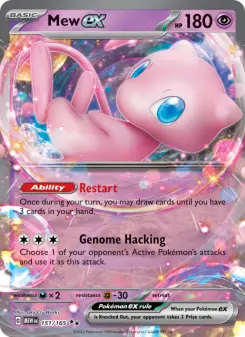
ExampleThe “151” set, released in 2023, has 165 numbered cards: Mew ex is number 151/165.
- Seriesseries
A run of sets sharing the same universe and the same card back. “Scarlet & Violet” and “Mega Evolution” are series.
ExamplePitch Black and Perfect Order, released in 2026, belong to the Mega Evolution series; 151, released in 2023, belongs to the previous series, Scarlet & Violet.
- Set code
The abbreviation that identifies a set: SV07 for Stellar Crown, ME02 for Phantasmal Flames. The first two letters give the series, the number its place in it.
Key pointA code ending in “.5” (SV8.5, ME2.5) signals an intermediate set, with a shorter print run than the main sets.
ExampleOn Mew ex, you can read “MEW” at the bottom left, next to 151/165: that is the code of the 151 set, printed on every card.
- Print runprint run
The quantity printed. It is never officially published; the market infers it from shelf availability and how long the product stays in distribution.
ExampleA set that stayed on the shelves for more than a year was almost always printed in large quantities; a set that vanished within a few weeks, the opposite.
- Reprintreprint
A second printing of a sold-out product. It inevitably brings down the market value of the first printing.
Key pointUltra-Premium Collections and anniversary products are not reprinted; regular boxes often are.
ExampleWhen a sold-out box is announced again, its secondary-market value often drops as soon as the announcement is made, before it is even back on the shelves.
- Prereleaseprerelease
A tournament held in shops two weeks before release, where you play with cards from the upcoming set.
ExamplePlayers use boosters from the upcoming set and leave with a stamped promo card that exists only for that event.
Rarities and artwork
The vocabulary of finishes and card variants.
- Holoholo
A card whose artwork is printed on a reflective background. The frame and the text stay matte.
ExampleWhen you tilt a holo card, only the artwork shimmers; the frame, the name and the attacks stay matte.
- Reverse holo
The opposite: the card’s frame shines and the artwork stays matte. Every booster contains at least one.
ExampleThe same common card exists in a normal version and a reverse holo version. In the site’s card database, the “Variants” line on the card page tells them apart.
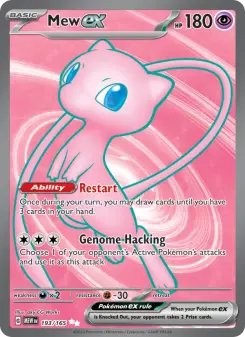
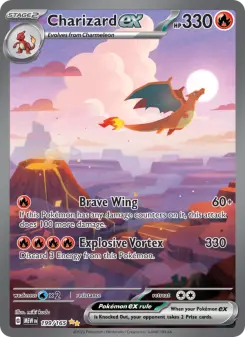
- Full artfull art
The artwork covers the whole card, frame included. The text sits on top of the illustration.
ExampleOn a full art Pokémon ex, the artwork runs to the edges of the card and the attack text sits directly on the image.
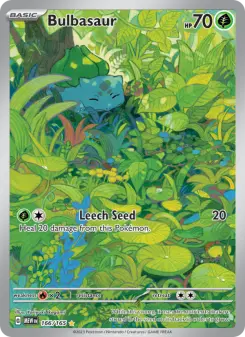
- Alternate artalternate art
A second, more narrative artwork for a card that already exists in a normal version. It is the most sought-after rarity in recent sets.
ExampleWithin one set, a Pokémon can exist with its usual battle artwork and with an everyday-life scene: the second often sells for several times more.
- Secret raresecret rare
A card whose number is higher than the set’s stated total: 198/191, for example.
ExampleIn the 151 set, any card numbered above 165 is a secret rare: 166/165, 200/165…
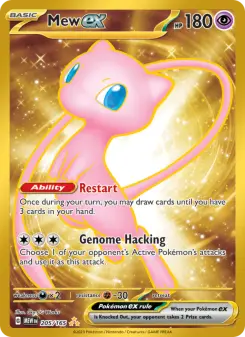
- Gold cardgold card
A card finished entirely in metallic gold, usually placed at the very end of the numbering.
ExampleGold cards are often Trainer or Item cards, placed at the very end of the set, after the other secret rares.
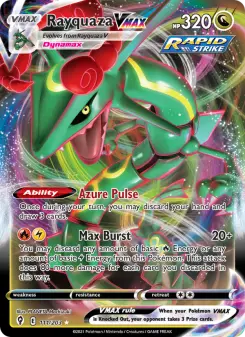
- ex, GX, V, VMAX
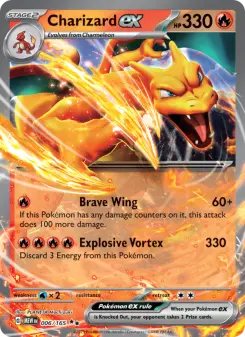
Successive game mechanics, each tied to an era: GX for Sun & Moon, V and VMAX for Sword & Shield, ex for Scarlet & Violet.
Key pointThe suffix dates the card at a glance, and tells you which sets to look for it in.
ExampleA “Charizard-GX” card necessarily comes from the Sun & Moon series (2017-2019); a “Charizard VMAX” card, from the Sword & Shield series (2020-2023).
- Jumbo cardjumbo / oversize
A large-format reproduction, about four times the size of a card. Decorative, not playable, and cannot be graded in standard slabs.
ExampleThe giant card slipped into some Premium Collections: decorative, for display, but with no play value.
- 1st Editionfirst edition
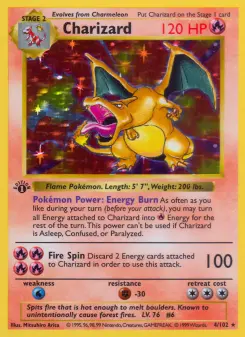
A stamp applied to the first print run of older sets, since discontinued. It multiplies the market value of cards from 1999-2002.
ExampleTwo Base Set cards that look identical: the one with the “Edition 1” stamp below the artwork, on the left, is worth far more than the other.
- Misprintmisprint
A badly printed card: missing ink, misaligned colours, a crooked cut, faulty text.
Key pointOnly known, documented errors hold collector value. A card that is simply off-centre or damaged during printing is not a sought-after error.
ExampleA card whose artwork is shifted by several millimetres, right into the frame, is a misprint. A border slightly wider on one side is only a matter of centring.
- Shadowlessshadowless
The very first English print run of the Base Set, recognisable by the missing shadow to the right of the artwork frame. Later print runs had the shadow added.
ExampleTwo English Base Set Charizards side by side: the one with no drop shadow to the right of the artwork frame is a “shadowless”, rarer than the other.
Collecting
What collectors aim for, and what they call it.
- Master set
Every card in a set, secret rares included, each in all its variants: normal, reverse holo, holo.
Key pointThere is no official definition: some include promos and stamped versions, others do not. Say what you are counting before buying or selling one.
ExampleThe 151 set has 207 cards, but its master set has far more: every common, uncommon and rare is added a second time as a reverse holo.
- Complete setcomplete set
The numbered cards of a set, from the first up to the stated total, without secret rares or variants.
ExampleFor 151, the complete set stops at 165/165; cards numbered 166 to 207 are not part of it.
- Chase cardchase card
The most sought-after card in a set, often an alternate or special illustration. It is what holds up the price of the boosters and booster boxes.
Key pointWhen the chase card loses value, the price of the set’s sealed products often follows.
ExampleIn Evolving Skies, the alternate art Umbreon VMAX and Rayquaza VMAX held up booster box prices for years.
- Raw cardraw
An ungraded card: neither assessed nor sealed in a slab. The stated condition is only the seller’s word.
Example“Raw, NM” in a listing: an ungraded card that the seller declares Near Mint. Check it against photos.
- Grailgrail
The card a collector is after above all others. It is personal to each collector: market value has nothing to do with the choice.
ExampleFor one, the Base Set Charizard; for another, the card from their first booster, found again twenty years later.
Opening boosters
The vocabulary of openings, in a shop, at home or live.
- Hit
Any card pulled from a booster above the regular rare: ex, full art, alternate art, gold card.
Example“Three hits in the box”: three cards above the regular rare, out of thirty-six boosters.
- Pull ratepull rate
How often a rarity comes out of boosters. The Pokémon Company does not publish it: collectors estimate it from thousands of openings.
Key pointA pull rate is an average, not a promise: a booster box can contain far fewer high rarities than average.
Example“One Special Illustration Rare every X boosters” is a community estimate; two booster boxes opened on the same day can give opposite results.
- God pack
An exceptional booster in which every rare card is a high rarity, often from the same series of artworks. Found mainly in Japanese sets.
ExampleA booster in which every card, from first to last, is an Illustration Rare: that is a god pack, not a run of lucky pulls.
- Casecase
The factory-sealed carton holding several booster boxes or several other boxes, as distributors deliver it to shops.
Key pointA case that is still sealed guarantees that no booster box has been removed or replaced.
ExampleCardmarket lists, for example, cases of ten Elite Trainer Boxes, delivered in their original carton.
- Live breakbreak
A product opened live on camera, often on a live-streaming platform. The cards go to those who bought the product or a spot in the break.
Key pointThe product must be shown sealed, and its wrap removed on screen: that is the only guarantee it was not opened beforehand.
ExampleA booster box of thirty-six boosters opened live, wrap cut on camera, each booster shown before it is opened.
Storing and protecting
What keeps a card in the condition it came out of the booster.
- Sleevesleeve
The soft sleeve you slide a card into as soon as it comes out of the booster. The first protection against scratches and dust.
ExampleA valuable card goes first into a soft sleeve, then into a toploader: the usual double protection for shipping.
- Toploader
A rigid plastic holder, open at the top, into which you slide a card that is already in its soft sleeve.
Key pointNever put a bare card in a toploader: it will get scratched. For grading submissions, companies often ask for a semi-rigid holder rather than a toploader.
ExampleA card fresh from the booster, slid into a soft sleeve and then a toploader, and taped between two pieces of cardboard for shipping.
- Magnetic holdermagnetic holder / one-touch
A rigid case in two halves that close with magnets, for displaying an ungraded card without handling it.
ExampleAn ungraded chase card on a shelf in a magnetic holder: protected, visible, and out in seconds if you decide to have it graded.
- Binderbinder
The album with pockets where a collection is stored, set by set.
Key pointChoose side-loading pockets and a binder that closes: top-loading pockets let cards slip out and dust in.
ExampleA nine-pocket binder closed with a strap: the 151 set fits into twenty-three pages, secret rares included.
A card’s condition
The four flaws that decide a grade, and the vocabulary to describe them.
- Centringcentering
How even the borders around the artwork are. A card cut askew has poor centring, expressed as a ratio: 55/45, 70/30.
Key pointIt is the first criterion grading companies mark a card down on, and the only one the owner cannot correct.
ExampleA 3 mm left border against a 2 mm right border gives 60/40 centring. For a PSA 10, PSA allows roughly 55/45 to 60/40 on the front and 75/25 on the back.
- Whiteningwhitening
The white line that appears along the edge when the coloured layer on the back chips away. Most visible on blue backs.
Key pointEven slight whitening rules out the top grade in practice. Check all four edges in the photos, not just the front.
ExampleA white speck on the back edge, visible without a loupe: in practice the card loses any chance of a 10, and often of a 9.
- Surface
The condition of the gloss layer: scratches, fingerprints, print dots, gloss creases visible under raking light.
ExampleUnder a lamp, with the card tilted, a fine scratch shows up on the shiny area. Invisible head-on, it still counts towards the grade.
- Cornerscorners
How sharp they are. A worn or slightly bent corner shows under a loupe and weighs heavily in a grade.
ExampleA slightly rounded corner, visible only under a loupe, is often enough to drop a card from a 10 to a 9.
- Mint, Near Mint
The scale used in listings between private sellers: Mint for perfect condition, Near Mint for a barely noticeable flaw, then Excellent, Good, Played.
Key pointThis scale is self-declared and unchecked. It has nothing to do with a grade from a grading company.
Example“Near Mint, straight from the booster into a sleeve”: that is the seller’s claim, to be checked against sharp photos of all four corners and the edges.
- Wrap crease
On a sealed product, a crease or tension in the cellophane. Harmless to the contents, but counted as a flaw by demanding buyers.
ExampleA box whose wrap is creased on one corner is still sealed, but some buyers will pay less for it than for a box with perfectly taut wrap.
- Pack weighingweighing
The practice of weighing boosters to find those containing a holo card, which is heavier, and reselling the rest.
Key pointIt is fraud. A batch of loose boosters sold by an unknown private seller deserves suspicion; a sealed booster box carries no such risk.
ExampleTwenty loose boosters from an older set, offered below market value by an unknown seller: that is the classic warning sign.
Grading
Having a card assessed by a third party: who, how, and what the grade tells you.
- Gradinggrading
The assessment of a card by an independent company, which gives it a grade, seals it in a slab and records its certificate.
Key pointGrading does not make a card better: it makes its condition verifiable by a third party, and therefore its price comparable.
ExampleYou send a card to a grading company; a few weeks or months later it comes back in a slab showing its grade and a number you can check online.
- PSA
Professional Sports Authenticator, the American company most followed on the Pokémon market. Grades from 1 to 10, with half-points from 1.5 to 8.5, and no published subgrades.
ExamplePSA 10 “GEM MT” is the most sought-after grade on the Pokémon market; a PSA 9 of the same card often sells for a fraction of that price.
- BGS
Beckett Grading Services. Publishes four subgrades (centring, corners, edges, surface) and an overall grade in half-points.
ExampleA BGS 9.5 with subgrades of 10 / 9.5 / 9.5 / 9.5: the card lost points on the corners, the edges and the surface, not on centring.
- CGC
Certified Guaranty Company. A later entrant to the card market, with no subgrades since 2023; it distinguishes a Pristine 10 from a Gem Mint 10. Values generally lower than PSA at the same grade.
ExampleA CGC Pristine 10 is valued above a CGC Gem Mint 10 of the same card: both carry a 10, but not the same designation.
- Gradegrade
The result of the assessment, from 1 to 10. On the market, the price gap between a 9 and a 10 is often wider than between a 7 and a 9.
ExampleIllustrative figures: a card at €40 in PSA 8 and €60 in PSA 9 can reach €200 in PSA 10. That last jump is what grading is all about.
- Subgradessubgrades
At BGS, the four detailed scores that make up the overall grade. They show where the card lost points.
ExampleSubgrades of 9.5 / 10 / 10 / 10: barely imperfect centring cost it the Black Label.
- Black Label
The black label BGS awards to a card graded 10 on all four subgrades. Rare, and valued far above an ordinary 10.
ExampleCentring 10, corners 10, edges 10, surface 10: the only combination that earns the Black Label.
- Slabslab
The sealed case the card is locked into after grading, with its label and certificate number.
Key pointOpening the slab voids the grade. A scratched or cracked slab can be replaced by the grading company, without a new assessment.
ExampleA slab’s label shows the card name, the set, the year, the grade and the certificate number.
- Certificate number
The identifier printed on the label. It can be checked free of charge on the grading company’s website, which shows the card, its grade and the date it was graded.
Key pointCheck it before buying any graded card. A number missing from the register, or whose photo does not match, points to a counterfeit.
ExampleEntering a slab’s number on the grading company’s website shows the card, its grade and, often for recent gradings, high-resolution photos.
- Population reportpopulation report
The public count, kept by each grading company, of how many cards have been graded for each card reference and each grade.
Key pointIt is the only verifiable measure of how rare a card is in a given condition.
ExampleFor a card graded 50 times as a PSA 10 and 5,000 times as a PSA 9, the 10 is a hundred times rarer in that condition, and its market value reflects it.
Grading companies, side by side
| Company | Country | Scale | Distinctive feature | On the European market |
|---|---|---|---|---|
| PSA | United States | 1 to 10, half-points from 1.5 to 8.5 | A single grade, no subgrades. Red label. | The global benchmark: the best values at the same grade and the easiest resale. Turnaround from Europe is often long. |
| Beckett (BGS) | United States | 1 to 10 in half-points | Four published subgrades. Black Label for four subgrades of 10. | Highly sought after for top grades, less followed than PSA for Pokémon cards. |
| CGC | United States | 1 to 10 | Pristine 10 above Gem Mint 10. No subgrades since 2023. | Present in Europe; values generally lower than PSA at the same grade. |
| SGC | United States | 1 to 10 | Black label. Pristine 10 above Gem Mint 10. | Mainly known for sports cards; little followed on the European Pokémon market. |
| PCA | France | 1 to 10, with designations above 9.5 | Optional subgrades. | Close by, with low shipping costs from Belgium. Recognised mainly on the French-speaking market. |
| CollectAura | France | Overall grade, with optional subgrades and measured centring | Illustrated label that picks up the card’s world. | Recent player, growing recognition. |
Prices and turnaround times change often: check them on the company’s website before sending anything. When reselling, a PSA grade remains the easiest to sell.
The market
The words you come across in listings and price reports.
- Market value
The price seen in recently completed sales, not the asking prices in current listings.
Key pointAn unsold listing is worthless as a reference. Compare only completed sales, over a short period.
ExampleA card listed at €150 by ten sellers but sold at €90 over the last few days: its market value is €90, not €150.
- Sealed vs singles
Two separate markets. Sealed product keeps without handling and sells as a whole; single cards require sorting, possibly grading, and selling one by one.
ExampleOpening a booster box to sell the cards as singles can bring in more than the unopened box, or much less: it all depends on the cards pulled.
- Return abuse
A buyer exercises their right of withdrawal after opening a product, or sends back a substituted item.
Key pointIn Belgium, the fourteen-day right of withdrawal applies to distance selling, but the seller may deduct any loss in value caused by handling that goes beyond trying the product out.
ExampleAn “unopened” box comes back with resealed wrap. Hence the value of photographing each product before shipping, wrap and edges included.
No term matches this search.
These words help you read a product page
Every item in the catalogue is described with this vocabulary: set, language, condition of the seal or case, and for graded cards, the grading company, the grade and the certificate number.
See the catalogueCard images: TCGdex. Artwork © Nintendo, Creatures, GAME FREAK, The Pokémon Company; Aurea Cards is not affiliated with these companies.